


You have funded your Pepperstone account and tested your EA. Then you see that Pepperstone offers a free VPS to some clients, and you wonder if you should use that or pay for your own.
The best VPS for Pepperstone is one hosted in a financial data centre near your broker’s servers, with guaranteed resources and a latency figure you can test before you pay. We run Forex VPS Hosting with cross-connection latency from 0.3ms, and we host in both London and New York, where Pepperstone’s servers sit. Pepperstone’s own free VPS is a fair option if you qualify. A paid, independent VPS suits you better if you want to choose your location and hardware, or if you do not meet the broker’s criteria. Below, we cover server location, the free VPS question, specs and setup.
Which VPS Server Location Is Best for Pepperstone Traders?
Pepperstone’s servers sit in two locations, New York and London, based on our own testing. Choose the data centre closest to the server your account connects to, not the one closest to where you live. Check your server name first, or ask Pepperstone before you buy a VPS, then test the real latency from that location before you commit to a plan.
If your account connects to a server in London, our London (LD4) Forex VPS is the natural starting point. If it connects to a New York server, our New York (NY4) Forex VPS is the better match.
Distance still matters, even at these speeds. A server in the same city as your broker’s execution servers shortens the network path your orders have to travel. A direct cross-connection is only possible when both servers sit in the same data centre. From any other city, your orders cross the wider network, so latency rises with distance.
No provider can promise an exact millisecond figure for your account without testing it. A published number is a starting point, not a guarantee. You can check live latency to your broker on our broker latency page before you spend anything.
How Do I Check Which Pepperstone Server I Am On?
Your server name appears in the login window of MetaTrader, for example, Pepperstone-Edge01. Match it against the tables below to see whether it sits in New York or London. If your server is not listed, or you cannot find its name, ask Pepperstone support which server your account uses before you buy a VPS. A VPS in the wrong city can add tens of milliseconds, as the figures below show.
What Latency Did We Measure to Pepperstone’s Servers?
We tested a sample of Pepperstone servers from a New York VPS, and the London servers from a London VPS. Fifteen of the 18 New York servers answered in under 1ms, between 0.51ms and 0.94ms. Three were slower: Pepperstone-Edge03 at 2.03ms, and Pepperstone-Edge11 and PepperstoneBS-Edge11 at about 13ms. PepperstoneBS-Edge11 is in Ashburn, Virginia, a different city from the rest.
For the London group, our London VPS measured Pepperstone-Edge14 at 0.60ms, PepperstoneGmbH-Edge14 at 0.56ms and PepperstoneEU-Edge14 at 1.65ms. From our New York VPS, the Edge14 and EU-Edge14 servers read about 68ms. That gap is why you should confirm your server before you pick a location.
Tested from a New York VPS
| Server | Entity | Latency |
|---|---|---|
| Pepperstone-Edge01 | Pepperstone Group Limited | 0.65 ms |
| Pepperstone-Edge02 | Pepperstone Group Limited | 0.61 ms |
| Pepperstone-Edge03 | Pepperstone Group Limited | 2.03 ms |
| Pepperstone-Edge04 | Pepperstone Group Limited | 0.81 ms |
| Pepperstone-Edge05 | Pepperstone Group Limited | 0.68 ms |
| Pepperstone-Edge06 | Pepperstone Group Limited | 0.70 ms |
| Pepperstone-Edge07 | Pepperstone Group Limited | 0.70 ms |
| Pepperstone-Edge08 | Pepperstone Group Limited | 0.69 ms |
| Pepperstone-Edge09 | Pepperstone Group Limited | 0.82 ms |
| Pepperstone-Edge11 | Pepperstone Group Limited | 13.37 ms |
| Pepperstone-Edge12 | Pepperstone Group Limited | 0.84 ms |
| PepperstoneBS-Edge08 | Pepperstone Markets Limited | 0.63 ms |
| PepperstoneBS-Edge11 (Ashburn) | Pepperstone Markets Limited | 13.34 ms |
| PepperstoneBS-Edge12 | Pepperstone Markets Limited | 0.82 ms |
| PepperstoneKE-Edge01 | Pepperstone Markets Kenya Limited | 0.51 ms |
| PepperstoneKE-Edge02 | Pepperstone Markets Kenya Limited | 0.61 ms |
| PepperstoneMU-Edge08 | Pepperstone Financial Markets Limited | 0.94 ms |
| PepperstoneUAE-Edge04 | Pepperstone Financial Services (DIFC) Limited | 0.71 ms |
| Pepperstone-Edge14 (London server) | Pepperstone Group Limited | 67.89 ms |
| PepperstoneEU-Edge14 (London server) | Pepperstone EU Limited | 67.82 ms |
Tested from a London VPS
| Server | Entity | Latency |
|---|---|---|
| Pepperstone-Edge14 | Pepperstone Group Limited | 0.60 ms |
| PepperstoneEU-Edge14 | Pepperstone EU Limited | 1.65 ms |
| PepperstoneGmbH-Edge14 | Pepperstone GmbH | 0.56 ms |
The screenshots below show the same readings in the platform’s server list.
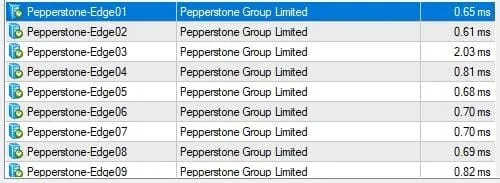
Measured latency from a New York VPS to Pepperstone-Edge01 through Edge09.
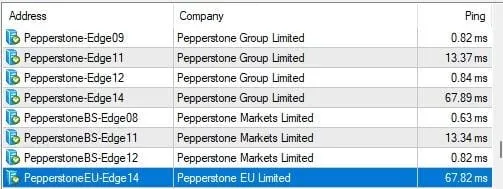
Measured latency from a New York VPS to Pepperstone-Edge09 through PepperstoneEU-Edge14. The two London Edge14 servers read about 68ms from New York.

Measured latency from a New York VPS to the PepperstoneKE, PepperstoneMU and PepperstoneUAE servers.

Measured latency from a London VPS to Pepperstone-Edge14.

Measured latency from a London VPS to PepperstoneEU-Edge14.

Measured latency from a London VPS to PepperstoneGmbH-Edge14.
A practical tip before you buy: look up your server name, match it to New York or London, and ask Pepperstone if you are unsure. Even within New York, results vary from server to server, so check your own server’s latency during a trial rather than relying on a table.
Does Pepperstone Give Me a Free VPS, and Is It Worth Paying for My Own?
Pepperstone offers free VPS plans, called Core, Plus and Pro, to active clients with a Pepperstone Pro account who meet its criteria. You request one through a form and receive your access details by email. If you qualify, it is a real benefit. If you do not, or your needs change, you need another option.
According to Pepperstone’s own VPS page, the free plans let you run trading platforms, EAs and automated strategies around the clock without relying on your home computer or internet connection. Access renews each month only while you maintain the required trading volume. The criteria are set out in Pepperstone’s VPS terms, so check them for your region before you plan around the offer.
On paper, Pepperstone’s free plans are larger than our entry plan. Its VPS page lists Core at 2 vCPU, 4GB of RAM and 100GB of disk space, Plus at 4 vCPU, 6GB and 150GB, and Pro at 6 vCPU, 8GB and 200GB. Our Advanced plan, with 2 cores and 4GB of RAM, is the closest match to Core. Size rarely decides it, though, because one or two EAs usually run comfortably on our 1-core, 2GB Standard plan. The more useful questions are where the server sits, whether you can keep meeting the volume condition, and whether you want control over the setup.
Here is the trade-off. A broker-provided VPS is tied to that broker’s programme, and its plan sizes are set by the broker. An independent VPS costs money from day one. In return, it stays yours regardless of your account status. It also lets you pick your location and hardware, and you can run other brokers’ platforms on the same server.
What VPS Specs Does a Pepperstone Trader Need?
For one or two EAs on a single Pepperstone account, a plan with one CPU core and 2GB of RAM is usually enough. If you run several terminals or heavier strategies, choose more cores and RAM, because each open platform uses its own share of memory and processing power.
Every plan we run uses an AMD Ryzen 9 CPU at 4.3GHz, DDR5 RAM, NVMe storage and a 10Gbps network, with cross-connection latency from 0.3ms. Our resources are guaranteed and run on Hyper-V virtualisation, so the RAM and processor time allocated to your plan are reserved for you. These are the monthly rates when billed annually on our Forex VPS Hosting plans:
| Plan | Monthly Price | CPU | RAM | Storage |
| Standard | $17.50 | 1 core, 4.3GHz | 2GB DDR5 | 30GB NVMe |
| Standard+ | $22.11 | 2 cores, 4.3GHz | 2.5GB DDR5 | 35GB NVMe |
| Advanced | $33.75 | 2 cores, 4.3GHz | 4GB DDR5 | 40GB NVMe |
| Expert | $63.75 | 4 cores, 4.3GHz | 8GB DDR5 | 50GB NVMe |
The Expert plan costs about 3.6 times the Standard price. For that, you get four times the cores and four times the RAM.
How Do I Set Up a VPS for Pepperstone?
Setup takes four steps. Connect to your VPS with Remote Desktop, install your MetaTrader platform, log in with your Pepperstone account details, then load your EA and test it on a demo account first. Once it runs correctly, you can close the connection and the platform keeps running.
Our servers run Windows Server, so MetaTrader 4 and 5 install the same way they do on a home PC. Two details save trouble later. First, set the platform to restart automatically after a server reboot. Second, check that your EA’s files and settings have copied across fully before you go live.
Server management is part of the plan, not an extra. Every plan includes cloud anti-virus and malware protection, off-site backups taken four times a week, and 24/7 support from a team that knows MT4 and MT5. We also publish a 99.99% uptime commitment, which excludes scheduled maintenance.
Before You Choose a Plan
The most common worry is paying for a VPS and finding it does not fit your trading. We publish a 30-day money-back guarantee on our VPS plans. It does not cover dedicated servers. You can also test latency from your chosen location on a short trial before you commit to a full year.
Get Started With a Forex VPS Built for Pepperstone Traders
If you want to see your real latency to Pepperstone before you commit, start with a trial. Start your 7-day Forex VPS trial for $3.99 and run your own account from London or New York, whichever matches your Pepperstone server.
Frequently Asked Questions
Should I choose a London or New York VPS for Pepperstone?
It depends on which server your account uses. In our tests, most of the Edge01 to Edge12 servers we tried answered in under 1ms from New York, while the Edge14 servers answered in under 2ms from London and about 68ms from New York. Check your server name in the MetaTrader login window, or ask Pepperstone, before you buy a VPS.
Can I move my EA from a Pepperstone VPS to an independent one?
Yes. MetaTrader runs the same way on any Windows VPS, so the platform behaves the same wherever it is hosted. Copy your EA files, templates and settings across, and run it on a demo account first.
How do I test latency properly before paying?
Start with our broker latency page, which you can check before spending anything. For a real test, run the 7-day trial and read the ping your platform reports for your Pepperstone server. Test at more than one time of day. Latency can change between the London open and the New York open, so check both if you trade both sessions.
Will a VPS stop slippage on my Pepperstone trades?
No. It shortens the delay between your platform and the broker. Slippage also depends on market volatility and liquidity at the moment you trade.
How many terminals can one VPS run?
It depends on RAM and CPU cores, not on the broker. The 2GB Standard plan suits one or two terminals. Running more on a plan that small can slow all of them down.
What happens to my open trades if the VPS restarts?
Your open positions stay on the broker’s servers. If you use stop-losses, they stay in place. Your EA only resumes if the platform starts again automatically, so set that up on day one.