


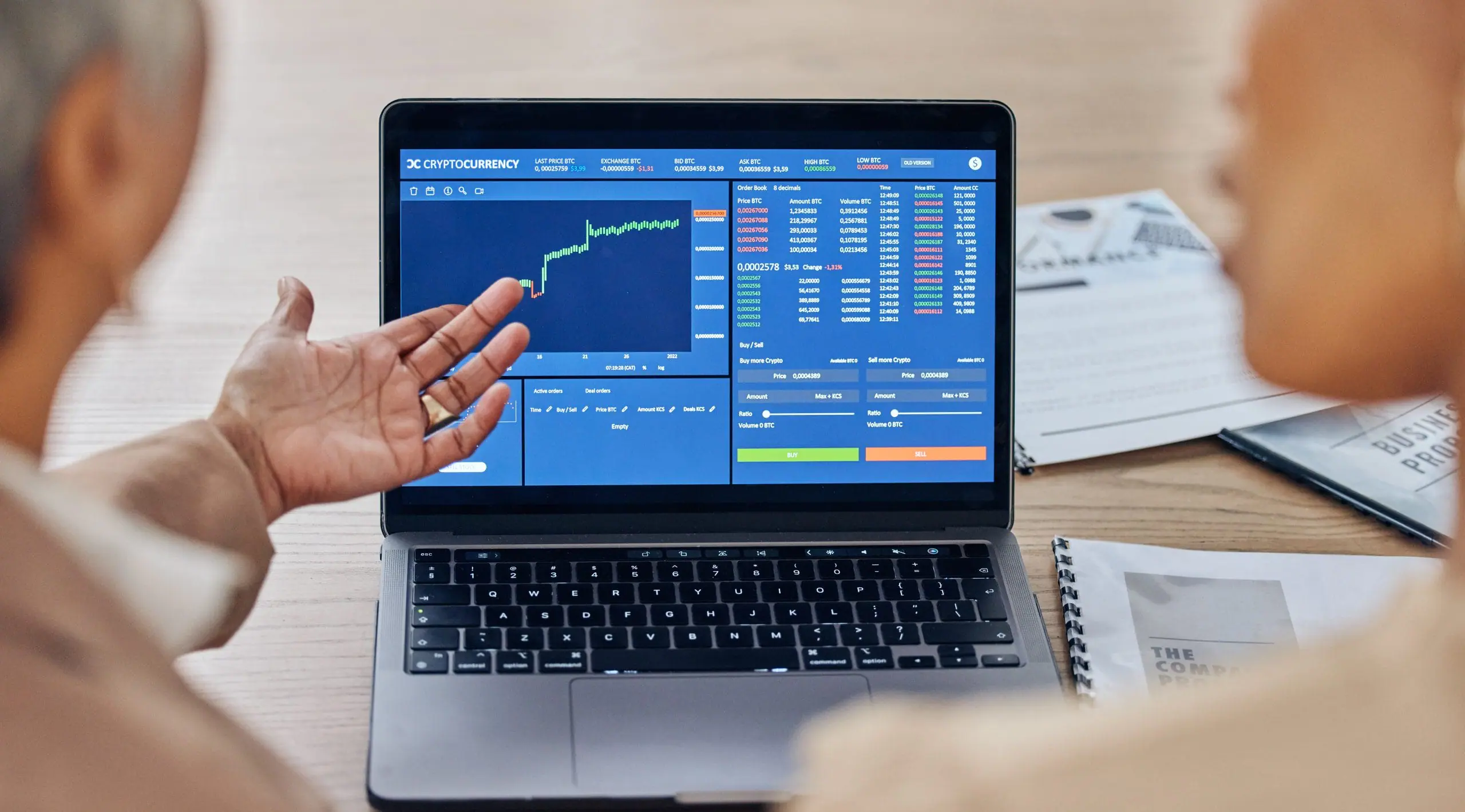
High-frequency trading (HFT), a specialised subset of algorithmic trading, is a type of trading that employs complex algorithms, advanced infrastructure, and very fast execution to capitalise on tiny price movements that occur in milliseconds.
High-frequency trading firms are completely different from ordinary trading desks. They are powerful tech-driven companies that blend finance, mathematics, and computer science to gain a competitive edge in the global market. The achievement of these firms is not only dependent on their clever strategies but also on the state-of-the-art hardware, low-latency networks, and ultra-efficient software systems that are faster than human reaction time.
What Defines a High-Frequency Trading Company?
A high-frequency trading company operates to execute a large number of trades in just a few milliseconds. Such companies depend not only on speed but also on accuracy and automation, using quantitative models to find the short-lived inefficiencies in the market. The major characteristics of HFT firms, including their role as market makers, are:
- Algorithmic precision: Their own algorithms carry out real-time analysis of the enormous market data to spot money-making opportunities for proprietary trading.
- Low latency: Firms pour a lot of money into infrastructure that maximises the reduction of execution delay.
- Automation at scale: Every second, a thousand orders are executed, modified, or cancelled without any human intervention.
- Huge data processing: Every day, the machine learning models analyse and interpret billions of data points to adjust their predictions.
Unlike retail traders who analyse charts manually, HFT systems execute fully automated decisions within microseconds.
The Technology Behind High-Frequency Trading
1. Co-Location and Data Centres
Almost instant market access is a characteristic of HFT companies that colocate their servers at or near exchange data centres, thereby reducing latency and improving execution speed. This closeness of servers to the trading platforms reduces trade execution time by as little as milliseconds, giving these companies a very important and sharp competitive edge in electronic trading. Exchanges like NYSE, CME, and NASDAQ have allocated space for such setups, with direct fibre connections between servers and market engines, facilitating electronic trading.
2. Advanced Networking and Latency Optimisation
The compilation of HFT companies is investing millions in custom-built fibre and microwave networks connecting the triad of financial cities: New York, London, and Tokyo. In high-frequency trading, the signal path transmitted through microwave and millimetre-wave networks is effectively faster than in a traditional fibre-optic network because the path is shorter and more direct, resulting in lower latency.
3. Specialised Hardware and FPGA Acceleration
The majority of trading systems rely on CPUs, but high-frequency trading companies prefer FPGAs (Field-Programmable Gate Arrays) – custom chips designed for low-latency data processing. This type of execution enables order processing with far lower latency than conventional servers by reducing the number of software layers and enabling direct communication with the network interface, essential for automated trading.
4. Algorithmic Strategy Design
A quantitative analyst and software engineer team at every HFT firm is working to build mathematical models that can forecast short-term price movements in quantitative trading.
Statistical arbitrage, market making, or liquidity provisioning could be the different strategies, crediting earnings from small, repeated margins rather than large speculative moves.
5. Artificial Intelligence and Machine Learning
In short, the year 2025 will likely see the majority of large HFT firms utilising market-aware, real-time adapting AI-driven algorithms; if not, some of them will probably be doing that even earlier. The algorithms are really fast at executing trades, as they consider factors such as volatility, trade volume, and the depth of the order book; thus, they can provide liquidity even more quickly and intelligently than ever.
Inside the Industry’s Leading HFT Firms
1. Jump Trading
As a pioneer of HFT, Jump Trading has been around since the early 2000s and sits at the crossroads of tech and quantitative research. Global markets are their main area of focus, and they have built infrastructure across various continents, where their teams are experts in low-latency systems, machine learning, and algorithmic strategy design.
2. Citadel Securities
Citadel Securities, a major player in market-making and one of the most famous names in that field, is continually strengthening its position by combining vast liquidity with the latest technology. Using its own systems, the firm processes millions of orders daily, helping maintain the liquidity of equities, derivatives, and other asset classes.
3. DRW Trading
DRW applies technology in a smart way across the different trades it performs in markets, both traditional and digital assets, and has thus become the firm of choice for traders with diverse skills. The company’s engineering wing is busy building algorithms that are very fast and respond to real-time market shifts. These are extremely well-connected to their analytics pipeline and data.
4. Hudson River Trading (HRT)
Hudson River Trading’s reputation as a research-driven trading company is enhanced by its employing dozens of quants and engineers who work together to develop and refine trading strategies. Their focus is always on the latest trends, cutting-edge technologies, and making the high-frequency trading process more efficient and cost-effective in the long term.
5. Tower Research Capital
The founder of Tower Research Capital is a former academic who, through research, has built one of the most elite infrastructures in HFT. Their trading activities cover a wide range of financial instruments, including futures, equities, and foreign exchange. They are supported by highly advanced distributed systems capable of processing thousands of transactions per second.
Boost Your Trading Infrastructure with Trading FX VPS
Speed of execution and reliability are non-negotiable – they are critical to the mission of automated trading. Trading FX VPS is designed specifically to grant traders that decisive technological advantage. Its ultra-low-latency servers and 99.99% uptime guarantee keep your trading systems online, responsive, and very fast.
Trading FX VPS offers NVMe SSD-powered performance whether you are running complex automated strategies, employing Expert Advisors, or connecting to global exchanges, with instant setup and data centres in London (LD4), New York (NY4), and Tokyo (TY3). Every site is designed for proximity to major financial centres, reducing latency to just milliseconds – a crucial factor for high-frequency trading.
With 24/7 access to experts, tailored VPS plans, and cutting-edge DDoS protection, you can concentrate on improving your tactics while Trading FX VPS maintains your systems’ security, stability, and speed.
It is time to improve your trading setup. Visit Trading FX VPS and enjoy seamless execution on par with the best for serious traders.