


When a trading strategy depends on speed, every fraction of a second matters. Algorithmic traders and EA users know this well: the gap between a filled order at the target price and a slipped entry often comes down to milliseconds. A forex VPS low latency setup positions trading software as close as physically possible to a broker’s trading server, shortening the network leg of execution and giving automated strategies a clean, stable environment to run from.
Lower network latency on its own does not guarantee a better fill. Final execution still depends on the broker’s own infrastructure, the liquidity provider behind the quote, spreads, order type, and market conditions at the moment the order is placed. A correctly located forex VPS removes network distance as a bottleneck; it does not remove the broker-side variables that also shape the outcome.
At TradingFXVPS, our infrastructure is built around direct cross-connects and fiber-optic routing into the world’s top financial data centers. This is not a general-purpose cloud server repurposed for trading. It is a purpose-built low latency VPS environment designed from the ground up for forex execution.
What Makes a Fast Forex VPS? (Hardware and Network Topology)
A fast forex VPS is not just about having a powerful processor. It is the combination of the right hardware, the right network architecture, and the right physical location working together. When any one of these elements is weak, execution suffers.
Processing power that does not throttle under load
Most shared hosting environments use virtualized CPU resources that get distributed across dozens of clients. During busy market hours, a VM may only receive a fraction of the processing capacity it was allocated on paper. TradingFXVPS uses dedicated high-clock CPUs running at 4.5GHz and above, so a trading platform and its EAs have consistent compute power available without shared contention or throttling during fast-moving markets.
CPU clock speed on its own does not determine trading latency. It affects how quickly a terminal processes incoming ticks and executes local logic, but the end-to-end latency a trader experiences is shaped just as much by network routing, the broker’s own infrastructure, and the distance between the VPS and the broker’s trading server. Dedicated CPU resources remove one potential bottleneck; they are a component of a fast forex VPS, not the whole story.
NVMe storage for instant platform response
Storage speed affects how quickly your trading platform loads, how fast historical data is accessed, and how smoothly your EAs process real-time tick data. NVMe solid-state storage operates several times faster than standard SSDs and dramatically faster than spinning hard drives. On a low latency VPS with NVMe storage, your MT4 or MT5 terminal launches in seconds, not minutes, and data reads happen with virtually no delay.
10Gbps redundant uplinks as the foundation
Network bandwidth alone does not define latency, but insufficient bandwidth creates congestion that adds jitter and inconsistency to your connection. TradingFXVPS provides unmetered 10Gbps redundant uplinks on every server. This means your data travels through an uncongested pipeline with full failover capability. If one uplink experiences any issue, traffic shifts instantly to the backup path without interrupting your open trades or active EAs.
Choosing the Best VPS for Reducing Forex Broker Latency
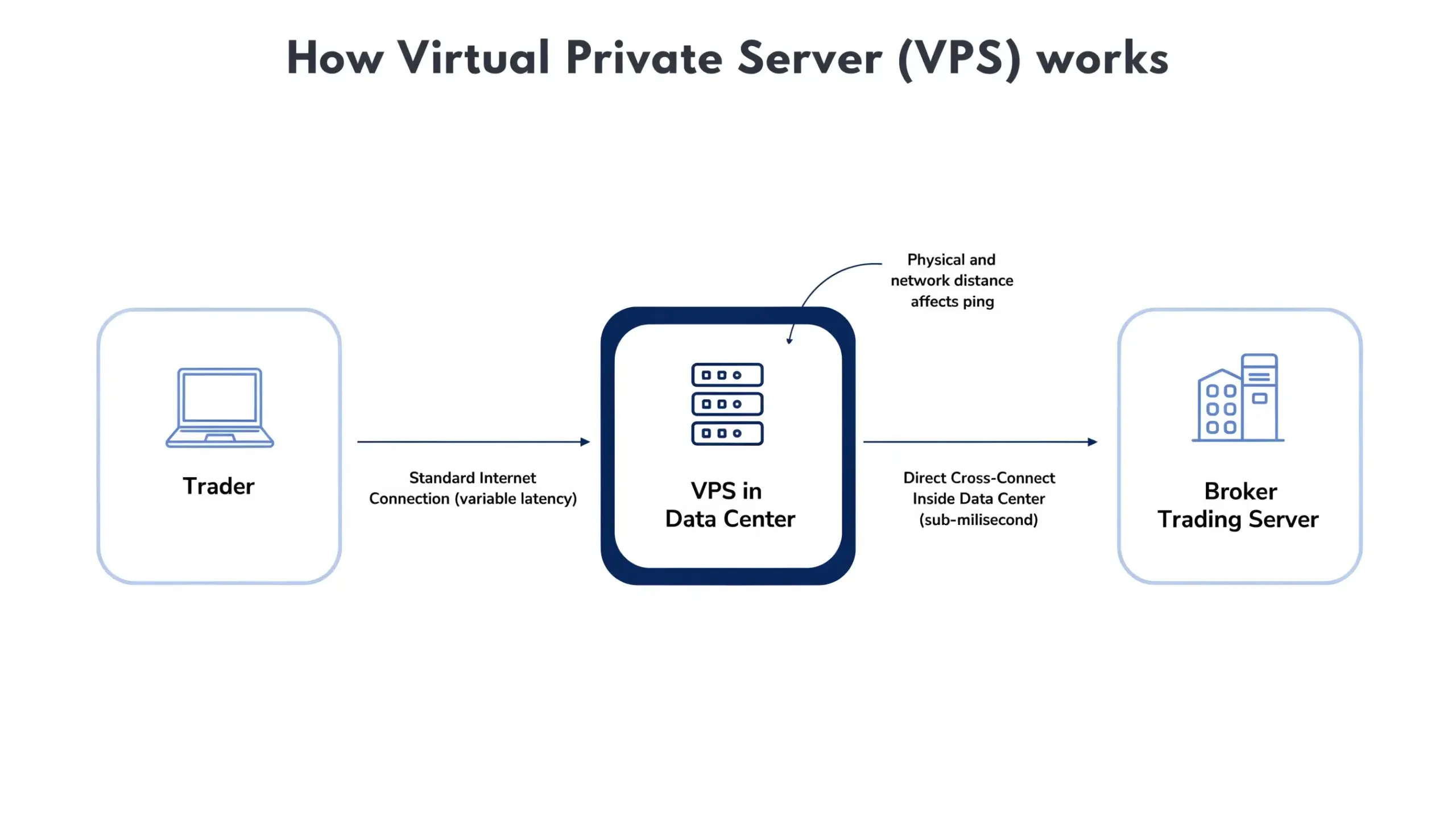
The best VPS for reducing forex broker latency is always the one physically closest to your broker’s trade execution server. This is a straightforward principle, but the execution behind it is highly technical.
Physical distance is the first variable
Light travels through fiber at roughly 200,000 kilometers per second. Even at that speed, distance adds up. A VPS located in a general data center in New Jersey but connected through multiple network hops to reach Equinix NY4 might show a ping of 8–15ms to a broker housed inside NY4. A VPS with a direct cross-connect inside NY4 might show 0.3–0.5ms to that same broker. That gap is enormous in algorithmic trading terms, where strategies are designed around tick-by-tick execution.
Fiber-optic routing and direct cross-connects
A cross-connect is a direct physical cable connection between two points inside the same data center facility. It bypasses the public internet entirely. When TradingFXVPS places your VPS on hardware inside or directly peered with Equinix NY4, Equinix LD4, or another major financial hub, your trading platform communicates with your broker over a private fiber path rather than routing through the public internet with all its hops, queues, and variable congestion.
This is how we achieve sub-millisecond ping to brokers hosted within the same facility. Public internet routing cannot match the consistency of direct colocation-grade fiber routing for execution-sensitive forex trading.
Jitter is as important as raw ping
A low average ping is good. A consistently low ping with minimal jitter is better. Jitter refers to variation in your network latency from one packet to the next. A connection that averages 2ms but swings between 0.8ms and 8ms will cause unpredictable EA behavior and order execution inconsistency. TradingFXVPS infrastructure is engineered to minimize jitter through dedicated network paths and traffic prioritization, not just to deliver fast average speeds.
Verified Latency Benchmarks to Major Financial Hubs
The numbers below represent benchmarked ping times from TradingFXVPS nodes to major financial exchange and broker infrastructure hubs. These figures are produced under live network conditions and reflect typical execution-hour performance.
These millisecond ping times are achievable because TradingFXVPS operates with direct network connections into these facilities, not through indirect routing paths. For algorithmic traders running latency-sensitive strategies, choosing a VPS node that matches your broker’s data center location is the single most impactful technical decision you can make.
Comparing Standard VPS vs. Dedicated Low-Latency Forex VPS
Many traders start with a general cloud VPS from a major provider and assume it will work well enough. For casual manual trading, it sometimes does. For algorithmic trading, EA execution, or any strategy that depends on precise order timing, the gaps become apparent quickly.
The noisy neighbor problem is one of the most underappreciated issues in shared VPS hosting. When another tenant on the same physical host runs a resource-heavy process, it can reduce your available CPU cycles, spike your disk I/O wait times, and inject latency into your network packets, all without any warning and entirely outside your control. TradingFXVPS isolates your resources so that your trading performance depends only on your strategy and your connection, not on what a stranger is doing on the same hardware.
Compatible Platforms and Execution Engines
TradingFXVPS supports the full range of trading platforms and execution engines used by professional forex traders. Whether you run expert advisors on MetaTrader, execute through a FIX API connection, or use institutional-grade order routing software, our low latency VPS infrastructure is tested and optimized for your environment.
[MetaTrader 4 and MetaTrader 5](https://tradingfxvps.com/visualization-os/metatrader-vps-platform/) are fully supported, including multi-terminal setups running several EA instances simultaneously. Our NVMe storage and dedicated CPU resources mean that even resource-intensive EAs with complex logic and large tick history datasets run cleanly without performance degradation.
cTrader runs exceptionally well on TradingFXVPS infrastructure, particularly for traders using cAlgo automated strategies. The combination of low jitter and sub-millisecond connectivity to LD4-hosted cTrader brokers gives cAlgo bots the clean data feed they need for accurate signal processing and order execution.
Rithmic and TradeStation users trading futures and FX futures benefit directly from our low-latency connectivity to CME infrastructure. Rithmic’s order routing protocol is highly sensitive to network consistency, and our dedicated 10Gbps uplinks with direct fiber routing ensure that your Rithmic-connected strategies receive stable, low-latency data and execution at all times.
FIX API bots and custom execution engines are also fully supported. Traders running proprietary algorithms through direct FIX API connections to broker servers benefit most from our cross-connect infrastructure, as FIX API latency is directly tied to the physical and network distance between your software and the broker’s matching engine.
Frequently Asked Questions About Broker Latency and VPS Performance
What is considered acceptable broker latency in forex trading?
For manual trading, anything under 50ms is generally comfortable and functional. For algorithmic trading and EA execution, acceptable latency depends heavily on your strategy type. Scalping strategies and high-frequency EAs benefit most from sub-1ms execution and should target a VPS with direct colocation to their broker’s data center. Swing trading and position-based EAs can tolerate slightly higher latency, but jitter and consistency still matter. A benchmark under 5ms with minimal jitter is a solid target for most automated strategies. Under 1ms, achieved through a cross-connect setup, is a strong benchmark for the network leg of execution, though it reflects VPS-to-server ping rather than the broker’s full order-processing time.
Can a VPS completely eliminate trade slippage?
A VPS cannot eliminate slippage entirely, but it can reduce it significantly. Slippage has two causes: network latency and market liquidity gaps. A low latency VPS addresses the network side by ensuring your order reaches your broker’s server as fast as physically possible, reducing the time between your EA’s trigger and the broker receiving the order. However, if a market moves sharply between the moment your order is sent and the moment it is processed at the broker’s matching engine, some price movement can still occur. Liquidity-based slippage is outside any VPS provider’s control. What TradingFXVPS does is remove the network latency contribution to slippage so that you are only exposed to genuine market movement, not preventable technical delay.
How do I measure my actual ping from the VPS to my broker’s trade server?
The most reliable method is to use the ping command or a dedicated latency testing tool directly from within your VPS. Log into your VPS via Remote Desktop, open a command prompt, and run a ping to your broker’s trade server IP address. Your broker’s trade server IP can usually be found in the MT4 or MT5 terminal under Tools, then Options, then the Server tab. For more detailed testing, tools like MTR (My TraceRoute) or PingPlotter show not just the round-trip time but every network hop along the route, helping you identify exactly where any latency is being added. If you are testing cTrader or FIX API connections, your broker’s documentation should list the relevant server IPs. TradingFXVPS support can also assist you in identifying the fastest node for your specific broker.
Getting the Most from Your Low Latency VPS Setup
Selecting the right Forex VPS plan is the first step. Getting the most from it requires a few additional considerations that many traders overlook when they first set up their algorithmic trading environment.
Always match your VPS location to your broker’s server location. If your broker is hosted at Equinix LD4, choose a TradingFXVPS node with direct connectivity to LD4, not a node in New York. The physical proximity principle is simple, but selecting the wrong node location can undo the performance advantages of even the best hardware.
Keep your VPS dedicated to trading tasks. Running additional software, large downloads, or non-trading processes on your VPS introduces CPU load and potential jitter that can affect your EA execution quality. A clean, lean VPS environment with only the necessary trading platforms and tools running will always outperform a cluttered one.
Monitor your latency regularly, especially after broker server migrations or network infrastructure changes. Brokers occasionally move their trade servers to new facilities or update their IP addresses. What was a sub-millisecond connection last quarter may have changed. TradingFXVPS support can help you recheck and reoptimize your node selection if your measured ping times change unexpectedly.
For algorithmic traders who take execution quality seriously, a low latency VPS built on real financial-grade infrastructure is a core part of the technical setup, not a guarantee of results. TradingFXVPS provides verified sub-millisecond network ping to major financial hubs, direct cross-connects, dedicated hardware, and support experienced with the forex trading community, while final execution quality still depends on the broker, the liquidity behind each quote, and market conditions at the time of the trade.